



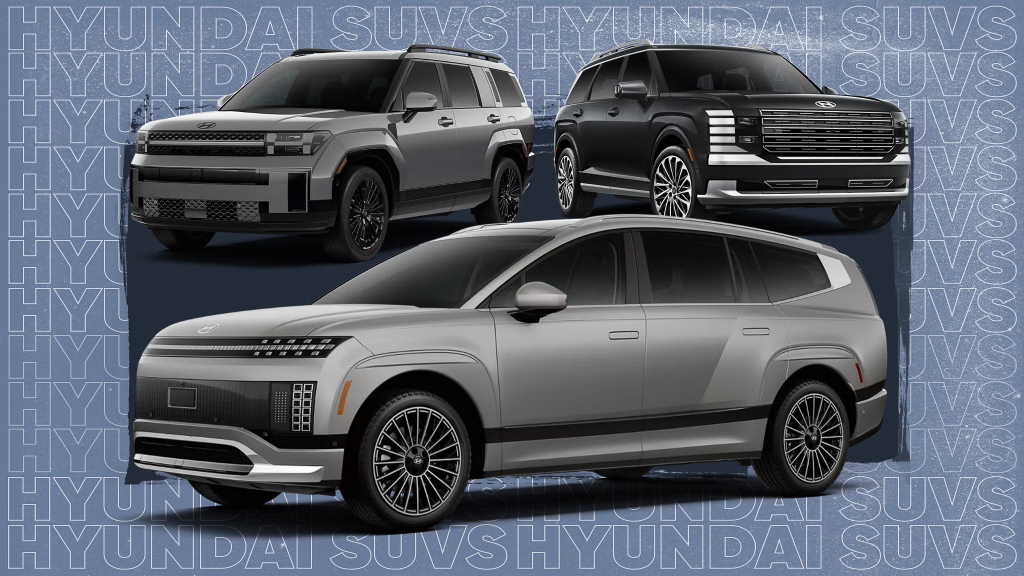
Which Hyundai SUV is best for a family? It’s one of the most common questions we hear, and the honest answer depends on how big your family actually is, and how often you need every seat filled. This hub page compares the full Hyundai SUV lineup, Kona, Tucson, Santa Fe, and Palisade, on the specs that actually matter for family shopping: seating, cargo, price, and real-world use case.
The Hyundai SUV Lineup at a Glance
Kona
5 seats · Smallest cargo area in the lineup · Best for individuals, couples, or small households
Tucson
5 seats · ~38 cu-ft cargo behind 2nd row · Best for smaller families without 3rd-row needs
Santa Fe
6-7 seats · ~14.6 cu-ft behind 3rd row · Best for growing families needing occasional 3rd-row seating
Palisade
7-8 seats · Up to 86.7 cu-ft max cargo · Best for larger families and regular 3rd-row use
Full Comparison Table
| Spec | Kona | Tucson | Santa Fe | Palisade |
|---|---|---|---|---|
| Starting MSRP | $25,500 | $29,450 | $36,650 | $41,035 |
| Seating capacity | 5 | 5 | 6-7 | 7-8 |
| Rows | 2 | 2 | 2-3 (available 3rd row) | 3 (standard) |
| Cargo behind last row | Smallest in lineup | ~38 cu-ft | ~14.6 cu-ft | 19.1 cu-ft |
| Max cargo (seats folded) | Limited | Moderate | Moderate | 86.7 cu-ft |
| Hybrid available | No | Yes | Yes | Yes |
| HTRAC AWD available | Yes | Yes | Yes | Yes |
Tucson vs. Santa Fe: The Comparison Families Ask About Most
This is the most common cross-shop in Hyundai’s SUV lineup, and for good reason: the price gap isn’t huge, but the practical differences are significant.
The Tucson is a dedicated five-passenger, two-row SUV. It offers strong legroom in both rows for a compact SUV and, size for size, some of the more efficient cargo packaging in its class, at roughly 38 cubic feet behind the second row. For families who rarely need a third row and want a smaller footprint for parking and daily driving, the Tucson is usually the more practical, more affordable choice.
The Santa Fe steps up to six or seven-passenger seating, depending on whether you choose second-row captain’s chairs or a bench, and offers more overall passenger volume, meaning more shoulder and legroom across the cabin, even though its behind-the-third-row cargo space is smaller than the Tucson’s two-row cargo area. For families who occasionally need to carry a carpool group, grandparents, or extra kids, that flexible third row makes the Santa Fe worth the price step up.
Still deciding between the two? Compare the Tucson and Santa Fe side by side in person, or schedule a same-day test drive of both.
Kona: Best for Small Households
The Kona is Hyundai’s smallest SUV and the most budget-friendly entry point into the lineup. It seats five but with noticeably less cargo room than the Tucson, making it a better fit for individuals, couples, or small households without heavy hauling needs. A Kona Electric variant is also available for buyers wanting a fully electric compact SUV.
Palisade: Built for Larger Families
The Palisade is Hyundai’s largest and most capable SUV, seating seven or eight depending on configuration, with a standard third row rather than an optional one. Its 86.7 cubic feet of maximum cargo space with the rear seats folded is by far the most in the lineup, and it’s recently been redesigned with an available hybrid powertrain for improved efficiency. For families who need the third row in regular use, not just occasionally, or who frequently haul gear for sports, camping, or road trips, the Palisade is the clearest fit.
Which Hyundai SUV Fits Your Family?
- Individual or couple, minimal cargo needs: Kona
- Small family, no regular 3rd-row need: Tucson
- Growing family, occasional extra seating: Santa Fe
- Larger family, frequent 3rd-row use, maximum cargo: Palisade
Fuel economy is also worth factoring in if it’s a priority: the Santa Fe is EPA-rated at roughly 20 mpg city/29 mpg highway, while the Palisade comes in around 19 mpg city/25 mpg highway, with hybrid versions of both improving on those numbers meaningfully.
Frequently Asked Questions
Which Hyundai SUV is best for a family?
It depends on family size. The Tucson suits smaller families who don’t need a third row, the Santa Fe fits growing families needing occasional third-row seating for six or seven, and the Palisade is built for larger families needing seating for seven or eight and maximum cargo space.
Tucson vs. Santa Fe: what’s the main difference?
The Tucson is a five-passenger, two-row SUV, while the Santa Fe offers six or seven-passenger seating with an available third row. The Santa Fe also offers more interior passenger volume, while the Tucson offers efficient cargo space behind the second row for its size.
Which Hyundai SUV has the most cargo space?
The Palisade offers the most cargo space in the Hyundai SUV lineup, with up to 86.7 cubic feet of total volume with the rear seats folded, compared to about 38 cubic feet behind the second row in the Tucson.
Is the Hyundai Kona a good family SUV?
The Kona works well for individuals, couples, or small families without significant cargo or third-row seating needs. Families needing more space typically move up to the Tucson, Santa Fe, or Palisade.
Do Hyundai SUVs come with all-wheel drive?
Yes. The Tucson, Santa Fe, and Palisade all offer available HTRAC all-wheel drive, useful for Missouri winter driving conditions.
Final Thoughts
There’s no single “best” Hyundai SUV for every family, only the one that matches how you actually use a vehicle week to week. The Tucson covers most small families efficiently, the Santa Fe adds flexible extra seating without going full-size, and the Palisade delivers maximum space for families who need it regularly. The Kona rounds out the lineup for buyers who want SUV styling without SUV-sized needs.
Ready to compare them in person? Visit McCarthy Hyundai of Blue Springs at 3000 NW South Outer Road, Blue Springs, MO 64015, browse the full SUV inventory online, or call 816-224-7500 to schedule a test drive.


